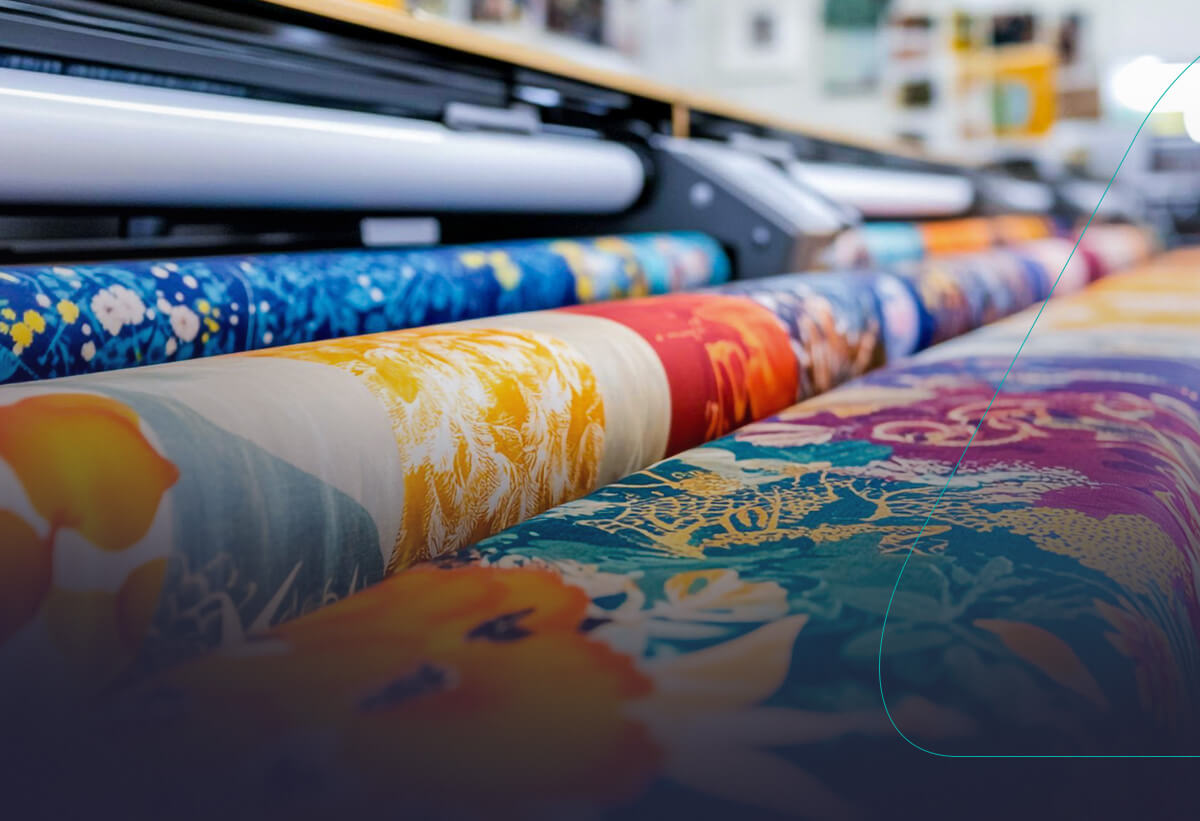
Digital printing has been gaining increasing prominence in the textile market. As a result, it is natural for questions to arise about what it is and what impacts it can have on operations.
With this in mind, we have gathered the main information on the topic to help clarify your questions and expand your understanding of this technology.
After all, understanding this trend now can be an important competitive advantage, allowing you to stay ahead of the competition.
So, keep reading!
What is digital printing?
Digital printing is, in fact, a natural evolution of traditional textile printing processes. This technique is designed for industrial production and delivers greater automation, precision, and technological integration.
It consists of transferring a design, which, in this case, is a digital file, onto a product, making it easier to manufacture clothing and textile fabrics, for example. To achieve this, the process is fully integrated with digital systems and high-performance, technologically advanced textile machines.
It can mainly be performed in three ways:
- DTG (Direct to Garment or Digital Silk Printing): the fabric receives the design ink directly. It is suitable for small production runs;
- Sublimation: the design is first printed onto a special paper and then transferred to the fabric with the help of a calender. It is suitable for large-scale production;
- DTF (Direct to Film): the design is printed onto a film and then transferred to the fabric. It is suitable for small production runs.
Digital printing has also gained prominence for enabling high-resolution designs, vibrant colors, and greater control over the entire operation.
This is because this stage of the textile production chain can be connected to systems such as ERP and MES, enabling:
- Real-time management;
- Reduction of textile waste;
- Resource optimization;
- Greater production efficiency.
In practice, this means that digital printing does not simply print designs; it is also part of a smarter and more connected production process, capable of supporting large volumes with consistency and high quality.
Read also: Textile industry machinery: a complete guide from spinning to garment manufacturing
What is the difference between a print and a pattern in sublimation?
Understanding the difference between a print and a pattern is an important step, as it directly affects the sublimation result and, consequently, the digital printing process.
What differentiates these two techniques is the way the design is created, applied, and behaves throughout the fabric.
After all, a print is the graphic design applied onto the textile fabric, while a pattern is conceived from the fabric’s structure itself and developed during the weaving process.
Therefore, printing requires:
- Registration accuracy;
- Strict color control;
- Thermal stability.
That is why the more complex the artwork, the greater the demands on the printing technology used in the sublimation process.
A pattern, on the other hand, follows a repetitive and fixed logic, allowing the production process to be more linear and less affected by interventions.
In summary, while a print is more closely associated with applying a specific and creative design onto the fabric, a pattern is related to the construction of a repetitive structure already integrated into the material.
Read also: Digital and conventional printing: main differences
What are the main fabrics for sublimation?
The best results in digital printing through sublimation are directly related to the use of synthetic fabrics or fabrics with a high polyester composition.
This is because they ensure greater color accuracy, durability, and efficiency throughout the production process.
Some of the main options are:
- Polyester (PP): considered the ideal fabric for sublimation due to its resistance to wrinkles, shrinkage, and fading, ensuring greater print durability;
- Polyester-Cotton Blend (PA): a fiber blend composed, on average, of 65% polyester and 35% cotton. In this combination, polyester ensures ink fixation, while cotton adds softness to the fabric;
- Polyester Viscose Blend (PV): also a blend, generally with a proportion similar to polyester-cotton fabrics, but using polyester and viscose. Viscose provides a softer feel and slight luminosity to the fabric, while also contributing to ink absorption;
- Polyester Lycra (elastane or spandex): due to its elasticity, it allows for a better fit to the body without compromising print quality. It is widely used in sportswear, swimwear, and garments that require comfort and mobility, while maintaining vibrant colors and good durability;
- PET (polyethylene terephthalate): produced from recycled materials, such as plastic bottles, it offers good ink absorption, moisture resistance, quick drying, and excellent print quality, making it widely used in large-scale production.
Why is this a trend in textile printing?
Digital printing is a trend that has emerged to ensure greater development and higher-quality final results through process automation and activity optimization.
However, beyond that, this technique has gained prominence due to its positive environmental impacts.
Today, the scenario is as follows:
- The textile industry in Brazil consumes approximately 93 billion m³ of water per year, equivalent to 4% of all freshwater extracted worldwide;
- Up to 20% of global industrial water pollution is associated with processes within the textile supply chain.
Digital printing helps change this scenario. According to data, this technique significantly reduces water and ink consumption.
While rotary screen printing uses between 35 and 60 cc of ink per printed meter, digital printing consumes approximately 6 to 9 cc in the same process.
In addition, it helps reduce chemical waste and textile waste, which currently reaches 4 million tons per year in Brazil.
In other words, due to the efficiency of textile technology and production optimization, this technique helps minimize the environmental impacts generated by the process.
Of course, digital fabric printing is not the solution to all environmental challenges caused by the textile industry. However, it is the responsibility of companies in the sector to replace production methods with high environmental impacts whenever possible.
The gradual adoption of this approach will allow the entire industry to evolve together toward more environmentally responsible production.
After all, this movement encourages the textile sector to recognize the urgency of sustainability and, consequently, become more open to investing in other solutions, strategies, and tools that promote sustainable practices.
What are the benefits of digital fabric printing?
Given the impact of digital fabric printing, we can highlight some of the benefits this practice brings to the textile industry.
The first is related to productivity. We know that technology contributes to the development and evolution of production processes, and this is no different in this case.
With digital printing, it is possible to achieve mass customization, meeting the demands of modern consumers. At the same time, small-scale production also becomes viable due to improved resource management.
It also offers greater versatility and creative freedom. In other words, it enables the printing of unconventional patterns and textures that would be difficult or impossible to achieve through traditional methods.
In addition, process automation provides greater speed and agility in production, reducing costs associated with manual labor and operational errors. By eliminating rework, companies can not only achieve cost savings but also ensure greater efficiency and quality in the final product.
Finally, with digital printing, there is greater standardization of activities, making it easier to manage and drive the evolution of your textile industry. After all, it becomes possible to implement strategies more effectively and evaluate results with greater accuracy.
Main solutions for digital textile printing
Delta offers a portfolio of technological solutions designed for different stages of the sublimation and digital printing chain, focusing on efficiency and industrial-scale production.
The Digital Print Preparer PID100 is one of these solutions. It is an innovative technology in Brazil, designed for the fabric pre-treatment stage.
With a roll-to-roll process, it enables continuous and cost-effective operation, making it especially efficient for small production batches. Its automated drying control system contributes to greater process standardization, stability, and production automation.
In addition, the PID100 simplifies primer application and can be used for preparing different compounds, ensuring better performance during the printing stage. The result is textile printing with more vibrant colors, high image resolution, and greater wash fastness, enhancing the final quality of the textile product.
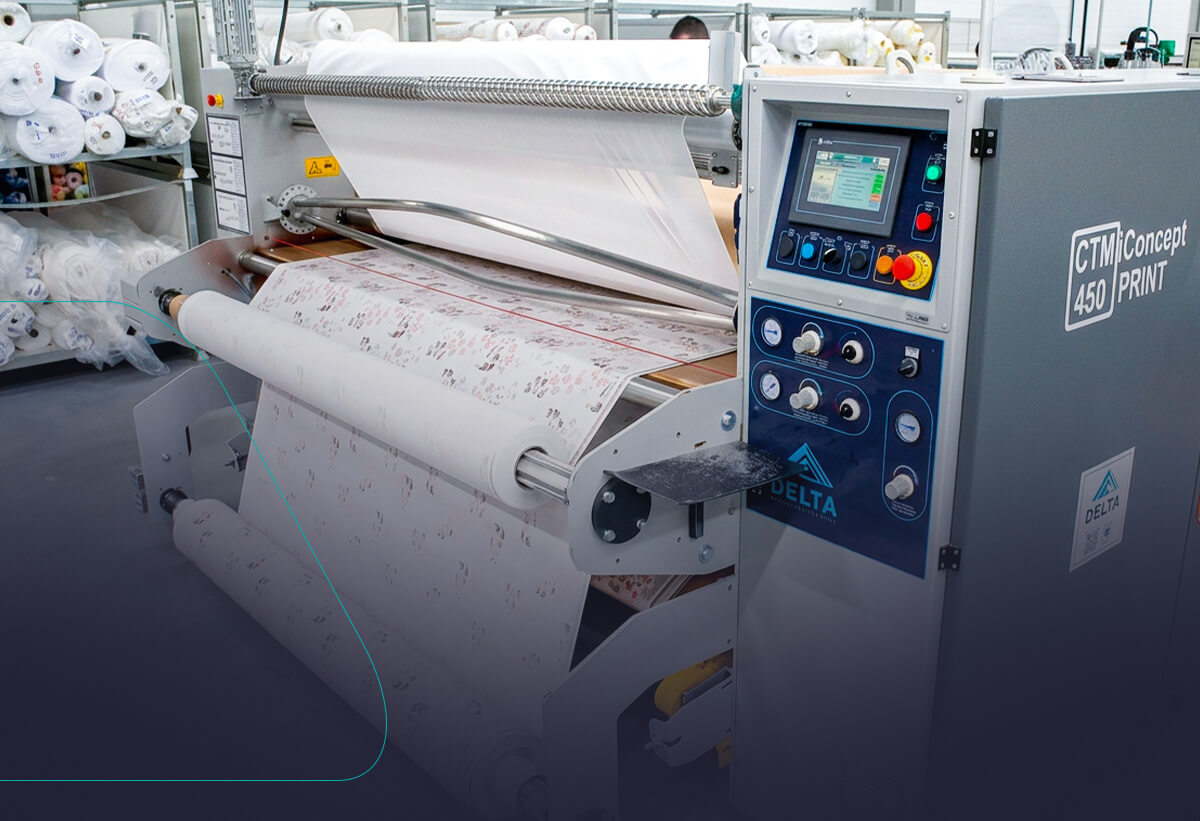
Complementing this ecosystem of solutions, the Transfer Calender CTM450 eliminates one of the main causes of variation in industrial sublimation: thermal inconsistency.
Its engineering ensures uniform temperature across the entire cylinder surface, with an automated heating system and better use of the working area, reducing issues such as:
- Color shade variations;
- Thermal ghosting;
- Quality fluctuations throughout production.
In practice, this translates into consistent printing from the first to the last meter, with lower waste rates and greater repeatability between batches.
The CTM450 was also designed to support high productivity, operating between 1.5 and 6 m/min, with precise adjustments through an HMI, recipe configuration, and greater process automation, reducing manual intervention and increasing consistency even across different operating shifts.
With a robust structure prepared for continuous operation, the calender integrates with Industry 4.0 concepts, enabling scalability with greater control, data visibility, and production predictability.
Discover more about these solutions: