
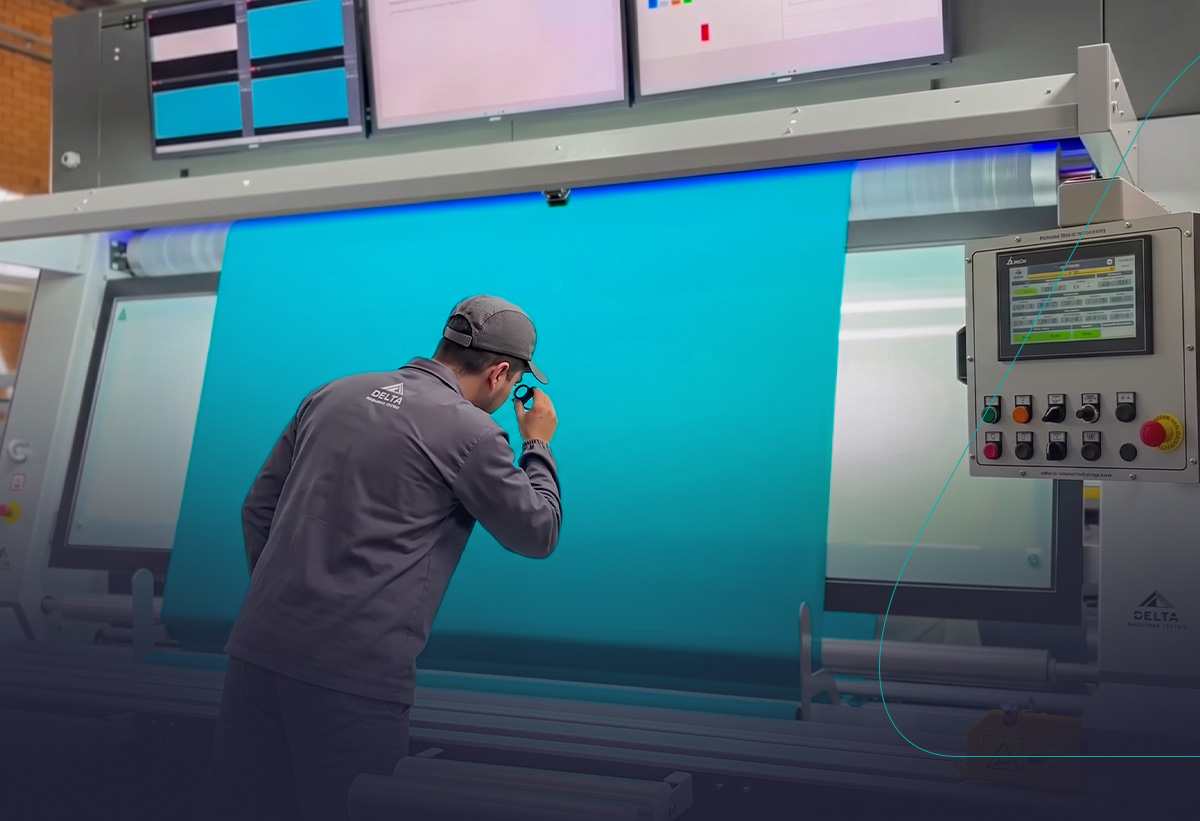
In the textile industry, small defects can have a major impact, leading to raw material waste, rework, lower productivity, and avoidable costs.
That’s why, rather than simply identifying defects at the end of the production process, it is essential to monitor operations and make decisions based on reliable information.
In this content, you’ll learn how technology and automation can make textile quality control more efficient and what benefits this strategy can bring to your operation.
Let’s get started!
What is textile quality control?
Textile quality control is a system adopted to prevent failures and problems in processes and solutions within the textile industry. Its goal is to efficiently meet production needs and customer expectations.
Therefore, it is not simply about checking and counting defects in finished products. Quite the opposite! The purpose is to anticipate potential problems and find solutions to prevent them from occurring.
It is worth noting that the textile quality control methods we know today emerged in the 20th century. However, the process dates back to the earliest buying and selling relationships throughout history.
From inspections carried out by artisans and guilds in the Middle Ages, through the standardization and quality control driven by the Industrial Revolution, the concept evolved toward statistical methods and, later, Total Quality Management.
With industrialization and increasing consumer demands, the focus shifted from simply identifying defects in the final product to preventing failures, standardizing processes, and continuously improving production.
In the textile industry, this evolution gained even more momentum with automation and the use of data, enabling more precise and preventive quality control at different stages of production.
What is the impact of automation on textile quality control?
Optimizing processes to improve and integrate work methodologies, reduce costs, and boost productivity. These are essential actions for the textile industry!
These practices are made possible through textile quality control, which collects, analyzes, and manages production process data.
In the textile industry, preventive quality control can help ensure the quality of production processes. The good news is that the sector is experiencing one of the most advanced stages in the evolution of quality control.
Traditionally, when a roll of fabric arrives at the garment factory, only the information provided by the manufacturer on the label is analyzed. Analyzing each roll individually would take a significant amount of time and reduce productivity, so many companies do not perform this process.
With Industry 4.0, technology can automate processes efficiently. In addition, textile quality control can be implemented at every stage, including when materials are received.
Therefore, investing in automation is essential to improve productivity, efficiency, and quality. After all, with the help of smart machines, errors and rework can be reduced, also resulting in lower costs and less waste.
But remember! Automation is based on the following pillars:
- Investment in modern equipment.
- Process changes and standardization.
- Strategic and effective management.
- Data monitoring and analysis.
What are the advantages of textile technology in quality control?
Investing in technology is a way to make processes more efficient, reduce losses, and increase the competitiveness of the textile industry.
When applied to textile quality control, technology makes it possible to automate processes, collect and analyze data more accurately, and identify potential problems before they progress through production.
And since each operation has different needs and challenges, these solutions can be adapted to each company’s specific reality.
In practice, this translates into benefits that go far beyond the quality of the final product.
Check out the main advantages and learn how technology can contribute to more efficient textile production!
1. Waste reduction
The lack of accurate information about raw materials and proper control throughout the production stages can lead to significant waste in the textile industry.
On the other hand, monitoring the technical data of a garment factory’s raw materials makes it possible to obtain accurate information about each fabric, such as:
- Length.
- Usable area.
- Fabric weight.
- Yield.
This makes it possible to choose the roll that will provide the best utilization (performance) for each cutting order. Based on this information, the fabric spreading and cutting processes can be planned with minimal waste.
In addition, textile technology provides an early view of key variables. As a result, it supports preventive textile quality control by providing management with the information needed to make better decisions.
Read also: How to guarantee high performance and quality in spreading?
2. Increased productivity
By automating textile quality control, the industry can also increase its production capacity.
After all, by replacing or optimizing manual processes, technology makes operations faster and enables companies to produce more without compromising quality.
One piece of equipment that serves this purpose, for example, is Delta’s Relaxing Machine.
It reduces the relaxation time from up to 48 hours to just a few minutes. In addition, it eliminates the rolling of tubular knitted fabric and provides accurate information about length and usable area.
Read also: What to Consider When Choosing New Machinery for Your Industry
3. Improved final product quality
When raw materials are inspected before manufacturing, it is possible to prevent garments from being produced using low-quality materials, such as those with stains or variations that could result in second-quality products.
Here, we can highlight Delta’s Inspection Machines for helping address quality issues in textile products.
The machine uses Artificial Intelligence to perform fabric inspection and detect fabric defects.
Therefore, textile quality control supported by smart machines helps deliver higher-quality final products. It also helps prevent financial losses for the company.
4. Cost reduction
Greater automation also means less labor, fewer material losses, and less space required.
As a result, production costs are reduced. This allows the company to pass these savings on to customers and offer products at competitive prices.
5. Improved material and machinery management
Collecting, analyzing, and managing data are key components of an effective textile quality control strategy.
With this information at hand, managers can monitor various data points, including potential issues that may be affecting productivity. They can also identify strategies to optimize the purchasing department’s operations.
6. Repeatability
When quality control is carried out effectively, the garment manufacturer can consistently achieve the same final result. This helps build customer confidence in the products they purchase.
After all, customers know what to expect from each product, strengthening the company’s credibility in the market.
How to implement effective textile quality control in a garment factory?
As you can see, textile quality control offers significant benefits to garment manufacturers, making it an essential practice.
However, to achieve the benefits mentioned above, it is important to take some precautions:
- Invest in efficient and smart textile machinery. This is essential for automating and standardizing activities, resulting in greater productivity and higher-quality final products.
- Reduce communication gaps by ensuring that employees understand the processes and how they work. Using management dashboards with transparent information can help with this task. It is also essential to update them in real time with the most important production indicators.
- Properly train the team responsible for operating the equipment to ensure that the solutions are used correctly and effectively.
- Analyze and update processes, preferably with the help of real feedback. Customer satisfaction surveys can be conducted, and the responses can be used to implement the necessary improvements.
Count on quality textile control experts!
Following production standards and carrying out rigorous textile quality control requires a great deal of dedication. However, in addition to contributing to market competitiveness, this approach also supports your company’s growth and development.
So, count on a company that understands the subject and has established expertise in the market to provide effective textile quality control.
As discussed throughout this article, Delta offers a range of solutions designed to support different stages of production.
Therefore, if you want to implement effective quality control, get in touch with us today!