
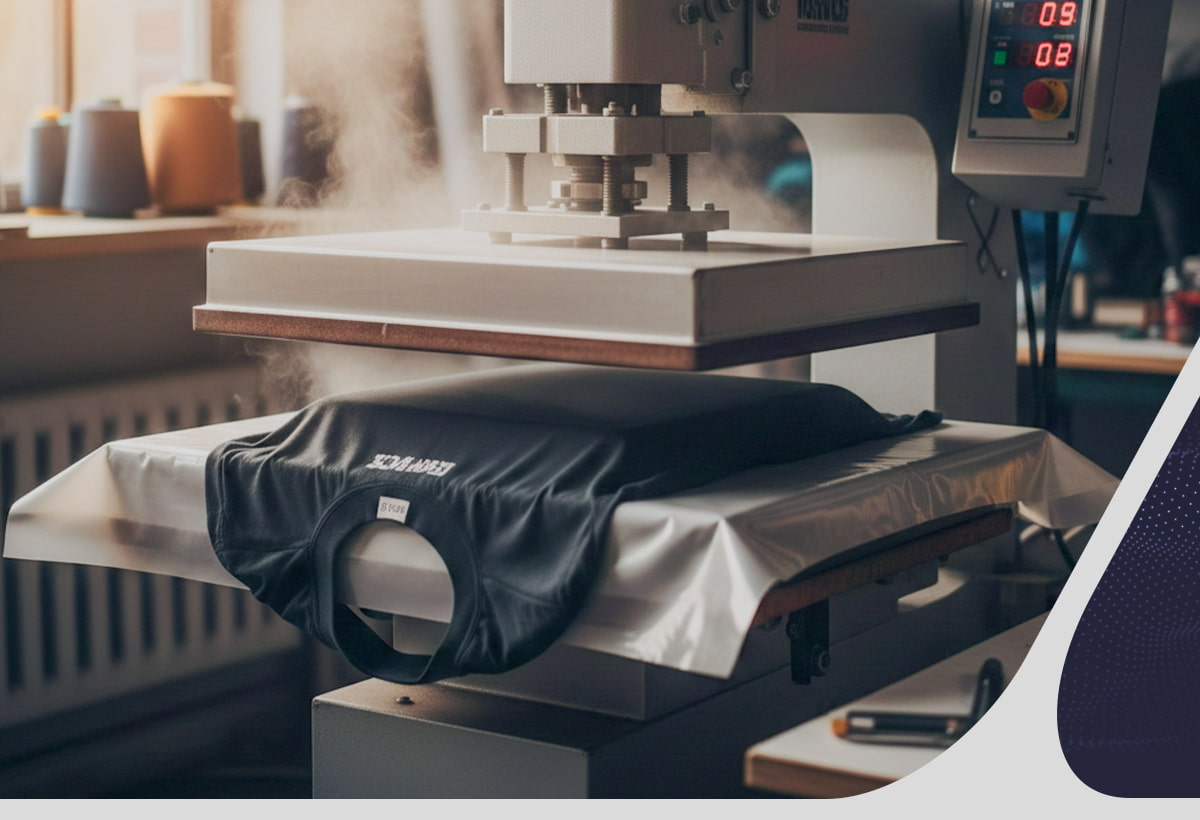
Sublimation printing is one of the most widely used processes in garment manufacturing to print fabrics with high quality, vibrant colors, and durability. To achieve this, two main types of equipment are used: the heat press and the transfer calender.
Both transfer pigment from sublimation paper to fabric through heat and pressure. However, they do so in very different ways.
Below, you’ll learn when to invest in a heat press, when it’s time to upgrade to a calender, and how to identify the exact moment to level up your production process.
Let’s get started!
When Should You Invest in a Heat Press?
The heat press is the entry-level textile equipment for garment manufacturers that are expanding into printing.
This is because it usually requires a lower initial investment, while still meeting the needs of smaller-scale production.
Therefore, you should invest in a heat press if:
- Production volume does not yet require high productivity: for operations with shorter cycles and moderate output, a heat press offers a good balance between cost and capacity;
- Budget is a decisive factor: for companies in the structuring phase, validating new products, or expanding gradually, it is a financially safer choice;
- The operation needs flexibility: it allows quick adjustments and on-demand customization. It is ideal for those working with a wide variety of items, short runs, and made-to-order demands;
- The team is still developing: a heat press requires less infrastructure and fewer changes to the factory layout, making implementation easier;
- The focus is on testing markets or expanding the product mix: if the strategy involves testing, launching small collections, or validating new lines, a heat press provides agility without straining the budget.
In this way, the heat press is the most suitable solution for garment manufacturers that are still growing and evolving, as it offers versatility and excellent cost-effectiveness.
When Should You Invest in a Transfer Calender?
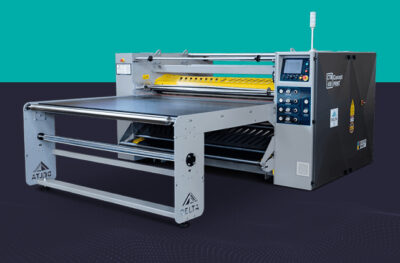
The transfer calender is the most suitable textile machine for garment manufacturers that have moved beyond the initial stage of printing.
In other words, it is the ideal solution for productions that need to turn productivity into industrial-scale output.
Therefore, you should consider investing in a transfer calender when:
- Production exceeds the operational limits of a heat press: the calender supports operations above 100,000 pieces per month or 100 tons per month, ensuring stability and consistent throughput for industrial garment manufacturing;
- You need to increase productivity without expanding the team: by operating in a continuous flow and requiring less manual intervention, the calender reduces rework and delivers real gains in output per hour;
- Production speed is a critical factor: the calender delivers speed measured in meters per minute, allowing large batches to be processed sequentially and with consistent standards;
- The focus is on consistency, repeatability, and industrial standards: for operations that require uniform quality across all batches, the calender provides more precise thermal control, pressure stability, and transfer uniformity;
- The investment must generate a clear return: although the initial investment is higher, the calender delivers accelerated ROI once demand is already established.
In conclusion, a transfer calender should be chosen when the garment manufacturer is already operating at high volumes and seeks to increase productivity efficiently.
In other words, when demand grows and the heat press starts to create bottlenecks, queues, or excessive overtime, it is a clear sign that the process needs to evolve.
Read also: Sublimation printing: how does it work?
Key Differences Between the Heat Press and the Transfer Calender
Each piece of equipment meets a specific production demand.
To make your decision about which machine is ideal for your garment manufacturing even easier, check out the key differences of each one, side by side, in the table below:
| Criteria | Heat Press | Transfer Calender |
| Productivity | Low to medium. Production limited by cycles. | High. Continuous flow. |
| Speed | Cycle per piece or per area. Depends on manual operation. | Measured in meters per minute, ensuring industrial-scale throughput. |
| Operation and Labor | Requires more manual intervention and more operators as volume increases. | Reduces the need for operators and offers greater stability. |
| Quality | Good, but subject to variations between cycles. | High uniformity with precise temperature control. |
| Repeatability | Can vary depending on operator, pressure, and positioning. | High repeatability with constant pressure and continuous flow. |
| Initial Investment | Low to moderate. | Higher. |
| Return on Investment | Gradual ROI, following demand growth. | Fast ROI in operations above 100,000 pieces/month or 100 tons/month. |
| Ideal Industry Profile | Small and mid-sized garment manufacturers, short runs, customization, and flexibility. | Factories and industries with high productivity and continuous demand. |
Read also: Clothing in Industry 4.0: what is the real productive gain?
How to Know the Ideal Time to Upgrade or Change Equipment?
Does your textile production already use a heat press, but you’re still unsure whether it’s time to move to a more advanced solution, such as a transfer calender?
Below are some signs that can help guide this decision:
- Current production already demands more than the heat press can deliver, operating at its limit with little to no output growth;
- Bottlenecks or queues in the printing process are affecting deadlines, quality, and operational costs;
- Monthly volume is growing consistently, exceeding 100,000 pieces per month or 100 tons per month;
- The company needs to automate processes, standardize stages, and increase predictability;
- Operating costs are too high due to excessive labor, rework, and textile waste;
- Textile product quality varies between batches or shifts, compromising repeatability;
- The equipment requires excessive industrial maintenance, frequently interrupting production.
If your garment manufacturing operation already shows signs of limitation, a transfer calender can become a strategic asset for increasing your industry’s competitiveness and profitability.
Read also: What to Consider When Choosing New Machinery for Your Industry
Why Is Delta’s Calender the Ideal Solution for Industrial Garment Manufacturing?
Delta Textile Solutions’s calender is designed for those who need large-scale, continuous production.
It reaches speeds of up to 6 meters per minute, with a thermally stable heated drum, ensuring uniform prints even in long production runs.
The use of 100% Nomex felt, a paper separation drum, and fixed winders helps reduce rework and printing defects. As a result, manual variations common with traditional heat presses are eliminated.
With HMI controls, this textile machine allows precise adjustment of temperature, pressure, and speed according to the material, delivering accuracy and repeatability.
In addition, textile automation and the roll-to-roll or piece-by-piece feeding system:
- Speeds up production;
- Reduces dependence on labor;
- Lowers cost per piece.
Therefore, for operations exceeding 100,000 pieces or 100 tons per month, Delta’s calender transforms printing into an industrial, consistent, and high-performance process.
Looking to grow efficiently? Then explore more details about this solution!