
The textile sector continues to grow, but the pressure for efficiency has never been greater.
Producing more with consistent quality, fewer losses, and greater predictability requires looking beyond installed capacity and carefully analyzing how preparation and finishing processes are being conducted.
In this context, textile stenter productivity is no longer just a matter of speed but depends directly on controlling critical variables, integrating production stages, and applying technology to the process.
Throughout this content, you will learn about the main factors impacting performance and how to address them in a practical, safe manner aligned with the current demands of the textile industry.
Shall we begin?
How to ensure textile stenter productivity?
The textile stenter is an essential piece of equipment for ensuring the quality of textile finishing.
However, for processes such as impregnation, structure alignment, controlled drying, and heat setting to occur as expected (without compromising the final result), it is crucial to pay attention to common mistakes throughout the process.
With that in mind, we will present the available solutions for these challenges, showing how it is possible to modernize your textile industry and enhance textile stenter productivity.
1. Fabric tension control
Fabrics such as knits, for example, may contain a higher elastane content in their composition, making tension control even more critical.
Although the textile stenter allows superfeeding control to promote shrinkage, it is essential to avoid stretching the material during the process.
For effective tension control, each stage of fabric entry must be monitored, from the centering device, unwinding system, and opening screws to synchronization systems, straightening mechanisms, and weft control, among other components.
Additionally, maintain well-defined standards and procedures in the production process and apply appropriate treatments to restore the fabric and its contraction to original conditions.
The Hydro Sprayer Station, for example, helps apply the precise level of moisture required for the fabric according to its composition, while also preventing process breaks by enabling finishing with softeners, flame retardant treatments, waterproofing agents, and more.
Also read: What to Consider When Choosing New Machinery for Your Industry
2. Needle control
Another essential feature for increasing textile stenter productivity is proper needle control.
Fabrics that have already gone through all production stages should be utilized to the fullest. Therefore, it is crucial to minimize selvedge cutting by introducing the textile fabric onto the needles continuously and as close to the edges as possible.
Some accessories can be attached to the stenter to assist in this process, such as:
- Branch Alignment and Insertion System: combined with a photocell and selvedge opener, this equipment is designed to promote efficient movement of the stenter rails into the correct position. As a result, it ensures the perfect positioning of fabrics/knits on the needle system;
- Selvedge Opener: equipment designed to remove folds and rolled edges from textile materials, typically used at the entry of the stenter chain;
- Selvedge cutter: equipment used to precisely and controlledly remove fabric selvedges, reducing losses and increasing process stability;
- Digital Ruler Sensor: eliminates reading errors common in conventional tape measurement methods, being used to monitor width variations in knits and fabrics.
3. Weight (grammage) control
In the case of elastic fabrics, grammage is rarely constant at the exit of the textile stenter because previous processes, handling, and fabric storage directly influence the final result.
Currently, many factories perform this control by sampling, taking one sample from each piece for cutting and manual measurement by an operator at the stenter exit.
Besides impacting textile production, this method is highly dependent on human intervention and does not allow continuous analysis of process variations.
Depending on how it is executed, it can also lead to defects, rework, and production setbacks. For this reason, the most recommended approach is to attach equipment at the stenter exit, enabling precise and continuous measurement of dried fabrics.
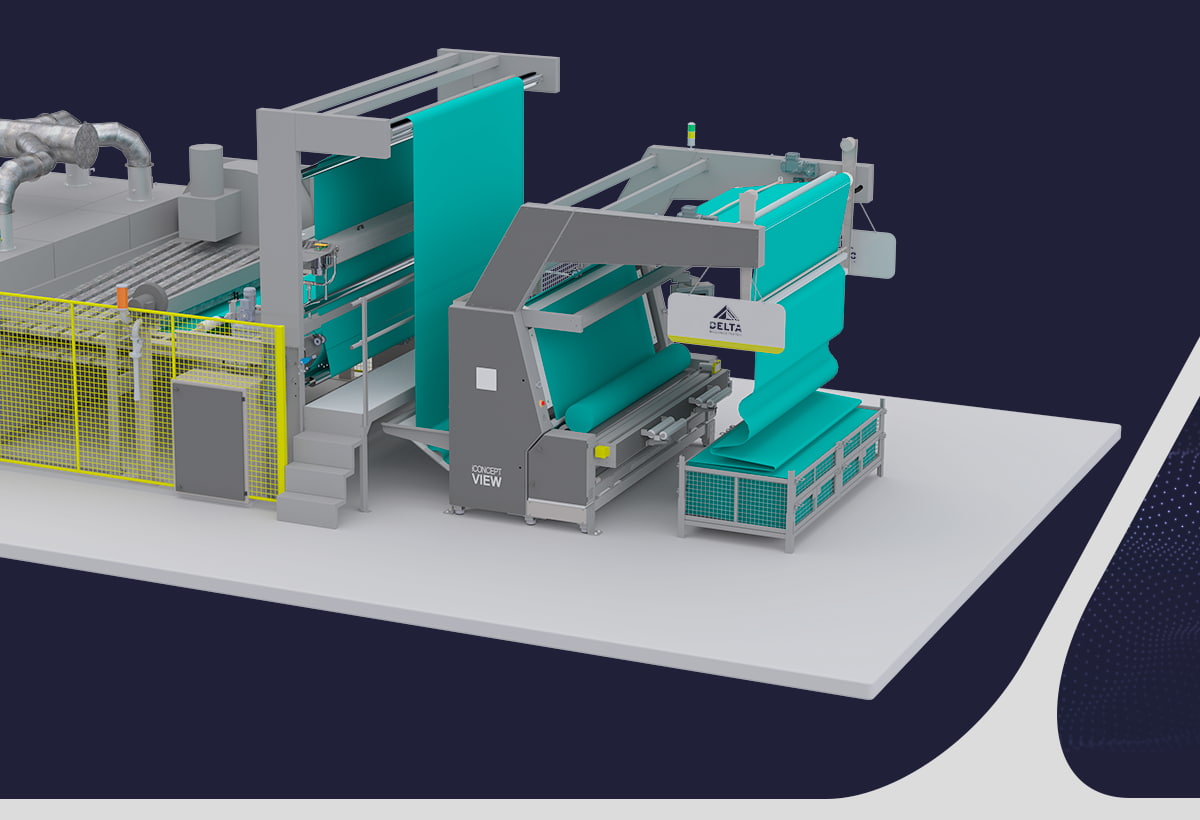
The Non-Stop Open Knit and Plain Fabric Reviewer inspection system can fulfill this function by collecting fabric data and analyzing potential defects.
Also read: Why does your production need a Delta Mesh Checker?
4. Impregnation uniformity issues
The lack of uniformity in chemical impregnation is a common problem that compromises textile stenter productivity.
When fabrics receive irregular amounts of products such as resins, softeners, or functional agents, variations in texture, color tone, and performance arise, leading to rework or even material rejection.
Furthermore, inconsistent application makes process control more difficult and increases chemical consumption, directly impacting operational costs.
The Impregnation Foulard is the ideal solution for this challenge because it ensures homogeneous and controlled application of products across the entire fabric width.
With properly adjusted pressure and dosage, the fabric enters the textile stenter in stable conditions, reducing variations and preventing rework.
5. Weft misalignment during processing
When the weft enters at an angle or becomes distorted throughout the process, the fabric develops visual defects, dimensional variation, and finishing problems, often making it unusable or requiring subsequent corrections.
This type of defect also compromises width control, needle alignment, and fabric stability, affecting overall textile stenter performance.
The weft straightener directly addresses these distortions by aligning the weft at the entry of the textile stenter process.
With the weft correctly positioned, the fabric progresses in a stable manner, ensuring quality and standardization, reducing losses, and improving operational efficiency, positively impacting textile stenter productivity.
Also read: What is quality control? How does it work in the textile industry?
Textile stenter productivity also depends on equipment quality
Even with well-adjusted processes, textile stenter productivity can be limited when the equipment does not provide the structure needed to sustain continuous operation.
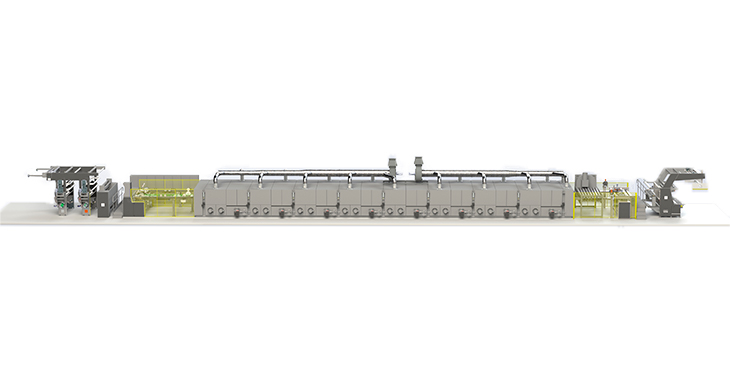
With this in mind, the Delta Textile Stenter was developed, a solution with Brazilian engineering designed to integrate textile technology, automation, and processes into a single piece of equipment.
With 18 years of expertise from Delta Textile Solutions, the stenter was engineered to transform the productivity of industries that need to grow without losing process control.
In a continuous process, the Delta Textile Stenter automatically performs the following stages:
- Impregnation.
- Structure alignment.
- Controlled drying.
- Heat setting.
This eliminates unnecessary movements, reducing cycle time and preventing bottlenecks between operations. The result is a more fluid, predictable, and efficient production process.
Furthermore, automated process control ensures consistent quality, dimensional stability, grammage control, and standardized hand feel, reducing variations that directly impact margins and competitiveness.
Designed for industrial applications, the Delta textile stenter establishes itself as a technological foundation for production expansion, combining performance, safety, local technical support, and financial viability.
Need to produce more with fewer losses and greater predictability? Explore this Delta Textile Solutions machinery!
