The textile industry operates in an environment increasingly pressured by efficiency, standardization, and process predictability.
With tight margins, high competitiveness, and growing quality requirements, understanding how each stage of the production chain influences the final outcome has become a strategic factor in industrial management.
In this context, spinning becomes a key point for decisions that impact operational performance, process integration, and the sustainability of the textile value chain as a whole.
Understanding how this stage connects to the other phases of textile production is essential for those seeking to improve processes with consistency and a long-term vision.
So, keep reading to learn more about this process.
What Is Textile Spinning?
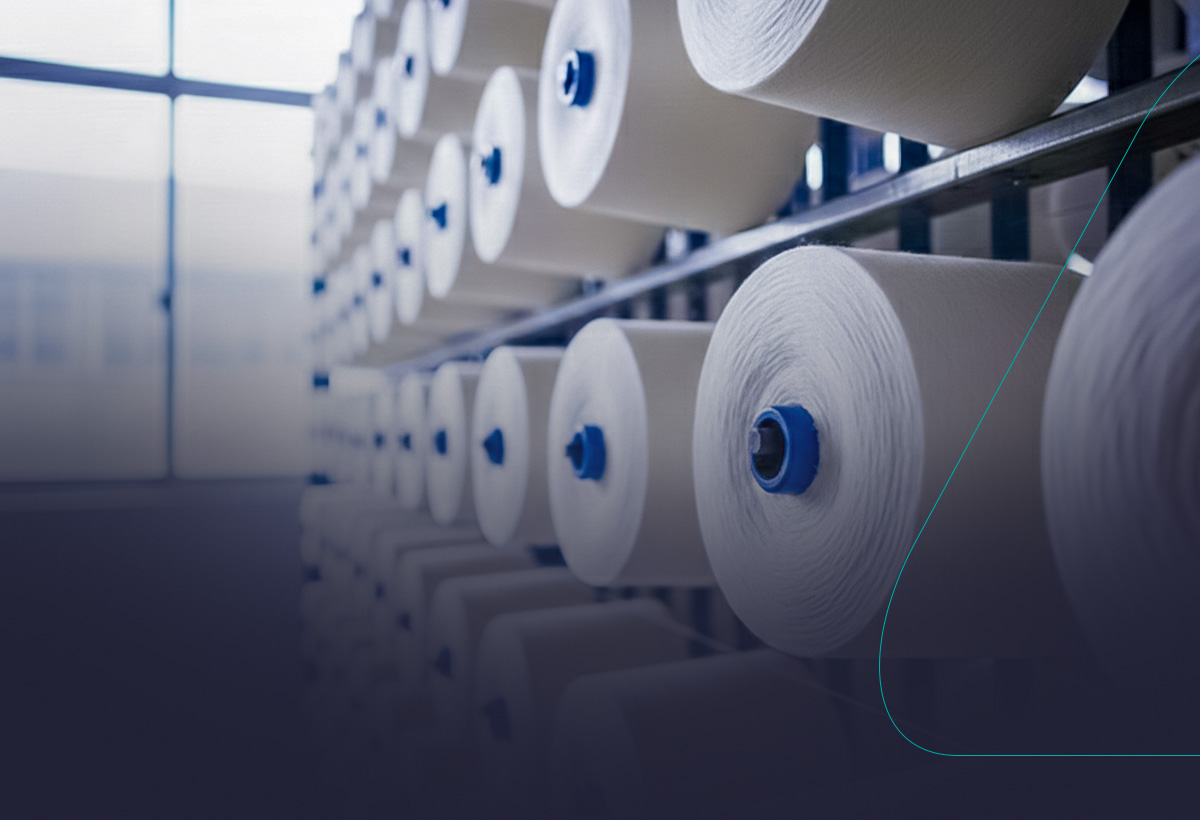
Textile spinning is one of the first stages in the production chain. After all, it is responsible for transforming natural, artificial, and synthetic fibers into strong and uniform yarns.
These yarns are then used in subsequent textile industry processes, such as weaving, knitting, garment manufacturing, and processing, for example.
The goal at this stage is to ensure that the textile fibers acquire cohesion, mechanical strength, and regularity. In other words, the properties required for further processing.
Not surprisingly, this is a crucial step for the entire production chain, as it establishes the quality standard that will be carried through all phases of the textile process.
Also read: Weaving Machines: How Automation Optimizes Production
How Is Spinning Carried Out in the Textile Industry?
Textile spinning is completed through a series of industrial stages. Although there are different textile technologies and methods, the basic principle of this phase remains the same: to organize, draw, and twist the fibers.
In general, this process can be divided into the following stages:
- Opening and cleaning of fibers: Fiber bales are opened and impurities such as dust and textile waste are removed to prevent contaminants from compromising yarn performance.
- Carding: The fibers are disentangled, aligned in parallel, and transformed into a continuous sliver. This process promotes greater uniformity and also removes part of the remaining short fibers.
- Drawing: Different slivers are combined and drawn in a controlled manner, helping to correct irregularities and ensure greater homogeneity in the yarn being formed.
- Twisting and yarn formation: At this stage, the yarn acquires its final characteristics, such as count, strength, and regularity, and can be produced using different spinning systems, such as ring or open-end.
It is worth noting that these are the core stages of the textile spinning process. Each manufacturer may add or reduce steps to ensure yarn quality.
Also read: What is quality control? How does it work in the textile industry?
What Are the Types of Textile Yarns?
The truth is that there are different types of textile yarns. This is because they can be classified according to their fiber origin, spinning process, or even their structure.
To make it easier to understand, we have gathered the main ones below. Check them out!
1. According to Fiber Origin
Textile yarns can be categorized based on their origin. In this case, they are:
- Natural yarns: produced from fibers of plant, animal, or mineral origin, such as cotton, wool, and silk;
- Artificial yarns: obtained from natural raw materials that are chemically processed, such as viscose, modal, and lyocell;
- Synthetic yarns: manufactured from synthetic polymers, such as polyester, polyamide, and acrylic.
2. According to the Spinning Process
The selected spinning process can also result in different types of yarns, such as:
- Carded: typically a more irregular and coarser yarn, usually thicker;
- Combed: a finer and lighter yarn, as it undergoes a combing process that removes impurities and irregular fibers;
- Open-end: produced through a process that uses high-speed rotors.
3. According to Structure
In terms of structure, textile yarn can be classified as:
- Single: composed of a single twisted strand. It is the most basic and widely used type in the textile industry;
- Ply (or twisted): formed by twisting two or more single yarns together, resulting in greater strength and dimensional stability;
- Textured: undergoes additional processes to gain bulk, elasticity, and a differentiated appearance, very common in synthetic yarns.
What Is the Role of Textile Spinning in the Production Chain?
Textile spinning holds a strategic position. After all, it determines yarn quality, as mentioned earlier.
This is especially important considering that yarn is the element that connects raw materials to the final product, directly influencing:
- The operational efficiency of subsequent machines;
- The uniformity of woven fabrics or knitted materials;
- The material’s behavior in chemical processes;
- Loss and rework rates throughout production.
However, it is important to emphasize that ensuring yarn quality is not a responsibility limited to the spinning stage. Maintaining this quality throughout the entire textile production chain is what ensures that the standard established at the source reaches the final stages intact.
After spinning, the yarn goes through different handling, transportation, storage, and preparation processes, during which it may experience physical variations, contamination, or damage that compromise its performance.
Breakage, deformation, loss of uniformity, and batch inconsistencies are examples of issues that often do not originate in the spinning process itself, but rather in the intermediate stages of the chain.
For this reason, yarn quality should be viewed as a continuous process, involving not only production control but also standardization and care at every interface between stages.
In conclusion, the more structured and integrated this management is, the greater the predictability of results and the operational efficiency of the textile industry as a whole.
Also read: Industry 4.0: the technological transformation of the industry
Next Steps
The role of spinning within the production chain opens the door to discussions about technologies, processes, and solutions capable of supporting yarn quality preservation throughout the industrial flow.
This context also requires looking at stages traditionally treated as purely operational, but which have a direct impact on the final result, such as the packaging of yarn packages.
The automation of this phase, for example, helps reduce variations and protect the yarn during handling, transportation, and storage, ensuring the product’s integrity through the next stages of the process.
With this in mind, Delta Textile Solutions developed the Automatic Packing System For Spinning Yarn Bobbins. It was designed to support spinning mills seeking greater safety, efficiency, and control throughout the industrial flow.
Learn more about this solution and ensure the quality of your yarns!