

OEE in the textile industry measures how effectively equipment is being utilized relative to its maximum potential, considering three main factors: availability, performance, and quality.
Therefore, when analyzed correctly, this indicator helps reveal production losses that often go unnoticed in the day-to-day factory routine.
More than just a number, OEE works as a strategic guide to increase production efficiency.
Below, you’ll understand how to interpret this data within the textile industry and which strategies can help turn this metric into real productivity gains.
How to interpret OEE data in the textile industry to identify bottlenecks in textile production?
Beyond simply calculating OEE in the textile industry, it is essential to accurately interpret the data generated by this metric throughout the operation.
After all, it is precisely this analysis that enables the identification of bottlenecks, production losses, and opportunities for improvement at each stage of the textile process.
However, to understand what the data is indicating, it is necessary to examine the three pillars of the indicator separately (availability, performance, and quality).
Here’s how!
1. Identifying Availability Losses
This is the OEE pillar in the textile industry that indicates the time a machine is actually producing compared to what was planned.
In other words, if it is low, it means production has been affected by stoppages that interrupt the flow. In this context, the main causes may include:
- Mechanical failures: equipment with worn or misaligned components can lead to recurring and unexpected failures, reducing machine availability.
- Corrective maintenance: when maintenance is performed only after a failure occurs, downtime tends to be longer.
- Setup time: in textile production, product changes, tension adjustments, yarn changes, or configuration modifications can require significant time. If these setups are not optimized, they end up reducing machine availability.
2. Analyzing Performance Losses
Performance refers to evaluating production speed by comparing actual output with theoretical capacity.
This is because, even when textile machines are running, different factors can prevent them from reaching optimal performance. For example:
- Frequent micro-stoppages: small interruptions, often lasting only a few seconds or minutes, may go unnoticed in daily operations. However, when they occur repeatedly throughout the shift, they end up representing significant productivity losses.
- Misalignments in the production process: synchronization issues between production stages (such as irregular yarn feeding, improper tension, or failures in the transport of textile materials) can reduce the pace of the operation.
3. Evaluating Quality Losses
Quality is related to the production standard, that is, the number of products that meet the expectations of a functional and aesthetically acceptable item.
Now, when the quality rate is low, part of the production is being lost or needs to be corrected. It is generally associated with:
- Rework: fabrics with defects may need to go through certain stages of the process again, increasing production time and operational costs.
- Fabric defects: issues such as weave faults, dimensional variations, stains, or imperfections can compromise the final product quality and lead to losses.
- Raw material waste: recurring defects also directly impact raw material consumption, increasing costs and reducing operational efficiency.
Strategies to Optimize the Three OEE Pillars in the Textile Industry
After evaluating the three pillars of OEE in the textile industry in search of the main production losses, the next step is to adopt strategies that can reverse this scenario.
To achieve this, efficient production management, process standardization, and the adoption of technologies capable of monitoring and controlling operations are essential.
Below, check out some strategies that can deliver consistent efficiency gains!
1. How to Increase Machine Availability
One of the most effective strategies to ensure that equipment remains effectively operating is the adoption of preventive and predictive maintenance.
This way, your industry will be able to anticipate problems, reducing unexpected downtime and increasing production reliability.
However, to achieve this, it is necessary to implement proper planning, aiming to concentrate maintenance interventions during scheduled periods to avoid disrupting the production flow.
Likewise, it is essential to ensure continuous equipment monitoring. Machine operating data, for example, helps identify patterns of wear, instability, and needed adjustments.
And this is where textile technology becomes essential! After all, in addition to reducing operational failures, it ensures automation and industrial control.
Also read: What to Consider When Choosing New Machinery for Your Industry
2. How to Improve Production Performance
When it comes to performance, one of the key strategies to improve this indicator is process standardization.
After all, when operations follow well-defined procedures, it becomes easier to maintain production stability and reduce variations that affect machine performance.
In this context, the automation of critical textile operations also becomes an ally. This is because it helps reduce reliance on manual adjustments, minimize operational errors, and allow equipment to operate closer to its ideal capacity.
3. How to Improve Quality and Reduce Losses
Finally, one of the key strategies to improve quality is to establish strict control over production parameters. Variables such as yarn tension, temperature, speed, and component alignment must be continuously monitored to ensure process stability.
Automated inspection and monitoring also play a fundamental role. Systems capable of identifying variations or defects throughout production make it possible to correct issues quickly, preventing failures from recurring in large production volumes.
Another important factor is reducing process variability. The more stable the operating conditions, the lower the chances of defects or inconsistencies in the final product.
The Role of Technology and Automation in Improving OEE
First, it is important to emphasize that OEE in the textile industry has a direct impact on ROI (Return on Investment). After all, as we have seen, this metric is a strategic tool for increasing the efficiency of productive resource utilization.
However, achieving this requires the support of technology and automation. These solutions are key factors in improving OEE.
The integration between equipment and management systems, aligned with Industry 4.0 concepts, makes it possible to transform operational data into insights. This enables more assertive decision-making and continuous improvement in production performance.
In this context, Delta’s solutions act as enablers of industrial efficiency, offering technologies that help optimize processes, increase machine reliability, and improve OEE indicators.
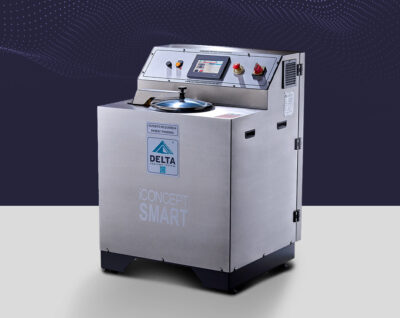
The Sample Washer Machine, for example, streamlines the shrinkage testing process by reducing analysis time from approximately 3 hours to just 20 minutes. As a result, the industry:
- Gains faster batch release;
- Reduces raw material waste;
- Improves quality control, directly impacting production efficiency.
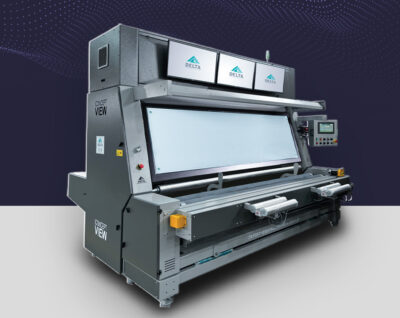
The Inspection Machine, equipped with artificial intelligence for automatic defect detection, increases productivity and ensures greater accuracy in raw material inspection. This:
- Reduces process failures;
- Helps improve production performance and quality indicators.
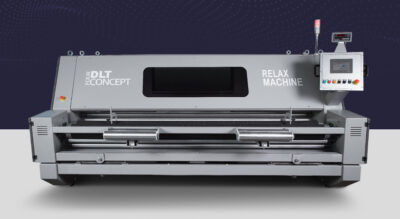
In turn, the Relaxing Machine eliminates the conventional 24 to 48-hour resting period of raw materials, allowing immediate fabric relaxation. This optimization:
- Reduces process steps;
- Improves production predictability;
- Prevents dimensional defects in cut pieces, contributing to greater operational stability.
Technology is the driving force behind efficiency in the textile industry!
Improving OEE in the textile industry means optimizing processes and using technology as an ally to achieve higher levels of efficiency.
In this sector, productivity, quality, and cost control are decisive factors for competitiveness. Therefore, automation, monitoring, and process standardization solutions make all the difference.
By reducing failures, increasing operational stability, and ensuring greater production accuracy, technology enables better use of installed capacity and supports increasingly strategic decision-making.
It is in this context that Delta positions itself as a partner to the industry!
Discover the technologies available for the textile industry.