The advancement of digital textile printing is reshaping the way the industry produces, bringing more agility, customization, and increasingly shorter production cycles.
According to Grand View Research, this market reached US$5.8 billion in 2024, with sublimation accounting for half of that revenue. The expectation is that the sector will reach US$11.6 billion by 2030.
In this context of rapid growth and increasing demand for efficiency driven by the evolution of this new technique, the industrial transfer calender stands out.
To learn how to scale your production with consistent quality in this scenario, keep reading!
What is the problem that currently compromises quality in industrial sublimation?
Even with the evolution of the textile sector, industrial sublimation still struggles to maintain consistency throughout production.
Some operations are even able to achieve good results in small batches. But as volume increases, the lack of thermal stability becomes a major bottleneck, significantly impacting quality, productivity, and predictability.
In these cases, thermal variation appears in several symptoms that are often treated in isolation. However, they are actually part of the same underlying problem. These include:
- Color tone differences between batches, even when the file and parameters are identical.
- “Ghosting” effects in prints caused by transfer variations.
- Inconsistent gradients with irregular color transitions.
- Constant rework to fix printing defects.
- Material waste due to out-of-spec production.
- Reduced productivity due to downtime for thermal adjustments.
The issue is that these deviations are treated separately. This leads to ink changes, tests with different paper, and repeated manual adjustments in a sequence of attempts that rarely solves the root cause.
Even with these changes, bottlenecks tend to persist. That’s because the focus remains on consumables, rather than on the thermal efficiency of the industrial transfer calender.
As long as this is not the focus, the operation will remain trapped in a trial-and-error cycle, correcting symptoms without addressing the cause. Until then, margins will stay compressed, customers will remain dissatisfied, and operations will remain unstable.
Read also: Sublimation printing: how does it work?
What is the impact of the quality of an industrial transfer calender?
If industrial sublimation is essentially a thermal transfer process, then consistency is the result of heat generation and distribution.
That is why, to a large extent, the thermal inefficiency of the industrial transfer calender is the main driver of result variations.
In other words, the lack of thermal uniformity across the cylinder causes different regions to operate at different temperatures, creating hotter and colder spots during the transfer process.
As a result, some areas end up with more intense colors, while others struggle with proper pigment fixation, leading to stains and loss of visual uniformity.
To make matters worse, when the process is not thermally stable, the responsibility for adjustments falls on the operator, leading to:
- Frequent manual corrections of temperature, pressure, or speed.
- Decisions based on trial and error.
- Results that vary depending on who is operating the machine.
In the end, the operation becomes dependent on constant human intervention, which limits both textile product quality and the ability to scale.
Therefore, to eliminate these issues, it is essential that your industry relies on a textile calender capable of ensuring precise thermal control. This means:
- Temperature equalization across the entire surface of the cylinder;
- Automated heating system.
- Recipe storage.
- Repeatable standards from the first to the last meter.
Read also: Learn what fabrics are used for sublimation
What happens when industrial sublimation starts operating with a quality standard?
In practice, the challenges of industrial sublimation become even more evident in operations that deal with high variety and short production cycles, such as Abrange.
Operating in the premium children’s fashion market, the company needs to manage dynamic collections, smaller volumes, and a high level of aesthetic demand. In this scenario, maintaining color consistency and quality is not just an operational issue, but a core part of the brand’s value proposition.
With growing demand for print diversity and faster development cycles, Abrange was facing dependence on third parties to handle sublimation.
This was mainly due to two factors:
- Limited internal production capacity.
- Difficulty in ensuring process standardization and predictability.
In addition to impacting deadlines, this model reduced control over final quality and limited the creative team’s speed of response.
The turning point came with the decision to bring sublimation in-house, seeking greater control over the process and better alignment with the specific needs of the business.
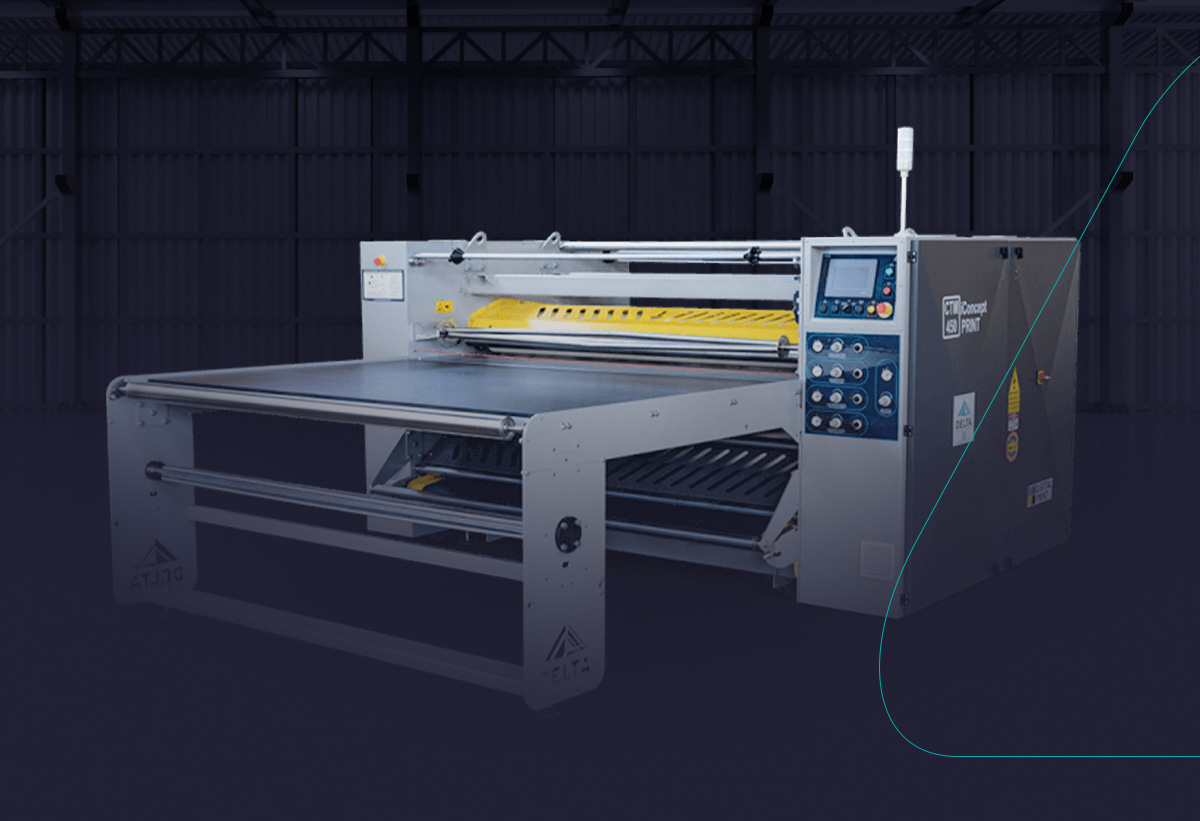
In this move, the implementation of the Transfer Calender CTM450 from Delta brought not only production capacity, but above all a new level of control over the thermal process.
With the new structure, Abrange began operating with more autonomy, predictability, and consistency, achieving:
- Elimination of color variation throughout production.
- Significant increase in productivity, with operation at higher speeds.
- Reduced dependence on third parties.
- Greater agility in developing and launching collections.
- Standardized output, regardless of volume or print complexity.
In practice, by gaining consistency and speed, Abrange strengthened both its creative capacity and its ability to deliver value to the market.
When should you invest in a more efficient industrial transfer calender?
Investment in an industrial transfer calender does not need to be driven solely by production capacity expansion. On the contrary, it should also be considered when there are clear signs of:
- Loss of control, even as the operation grows: what once worked in small batches starts generating inconsistencies at scale, requiring constant adjustments to maintain minimally acceptable quality.
- Difficulty maintaining consistency between shifts: even with the same defined process, results vary depending on who is operating the machine or the stage of production.
- High rework rates: frequent corrections, reprocessing, productive time loss, and material waste stop being isolated events and begin to directly impact margins.
- Dependence on specific operators: when only a few operators are able to achieve good results, the process is no longer reliable.
When these challenges arise, textile technology must evolve through investment in a more efficient industrial transfer calender.
Read also: Heat Press or Transfer Calender: Which Is Ideal for Garment Manufacturing?
What should you evaluate when choosing an industrial textile calender?
To truly acquire the best industrial textile calender, it is necessary to focus on several criteria that ensure the machine’s ability to deliver consistency over time, even under production scaling pressure.
Some key factors in this decision include:
- Thermal control: a good piece of equipment must ensure uniform temperature across the entire cylinder surface and maintain this standard continuously.
- Production stability: the ability to maintain thermal stability from the first to the last meter is what guarantees consistency in large runs and prevents variations within the same batch.
- Process automation in textiles: precise adjustments, interface-based control, and automated systems help keep the process within defined parameters, reducing the risk of human error.
- Operational repeatability: the ability to configure and save recipes allows different operators and shifts to reproduce exactly the same production conditions.
- System integration: connection with management systems, such as ERP, increases operational visibility, enabling data-driven decision-making.
- Speed as an ally: with precise thermal control, speed is no longer a risk factor but a controlled variable. In this context, there is no need to choose between productivity and consistency.
Read also: What to Consider When Choosing New Machinery for Your Industry
And the Delta Transfer Calender meets all these requirements!
When the focus shifts to thermal control and predictability, the choice of a textile calender becomes strategic for the operation.
That is why the CTM450 Transfer Calender from Delta was designed to address the root cause of variations in industrial sublimation.
Its thermal engineering ensures uniform temperature across the entire cylinder surface, with an automated heating system and better utilization of the effective working area, eliminating tone differences, thermal ghosting, and inconsistencies throughout production.
In practice, this translates into homogeneous printing from the first to the last meter, with reduced waste and repeatable standards across batches.
At the same time, the machine was developed to sustain real productivity. With operating speeds ranging from 1.5 to 6 m/min, precise HMI adjustments, recipe configuration, and process automation, the CTM450 reduces human intervention and ensures consistency even across different shifts.
Its robust structure, designed for continuous operation and aligned with Industry 4.0 principles, enables production scaling with control, data, and predictability.
Learn more about this textile solution!