The pressure for shorter lead times, lower costs, and increasingly higher quality standards has transformed the day-to-day operations of industrial garment manufacturing. In this scenario, increasing production volume without losing control has become an operational necessity.
The challenge is that, in practice, many of the issues that limit this growth are not solely related to production capacity, but also to how processes are managed and connected throughout the operation.
That is why understanding the dynamics of industrial garment manufacturing, and how to make it more efficient, has become essential for companies looking to scale consistently and sustainably.
Read on to learn more about this topic and discover practical solutions for improving performance.
What is industrial garment manufacturing?
Industrial garment manufacturing is a textile production model focused on producing items on a large scale, such as apparel, socks, accessories, home textiles, and even technical textile products.
However, this requires structured, efficiency-driven processes. Here, everything is planned to ensure consistency, predictability, and high production volumes.
In other words, each production step follows technical standards designed to reduce variations and prevent waste. The goal is not simply to produce more, but to produce better, with greater control over deadlines, costs, and product quality.
How does it differ from other manufacturing models?
The industrial manufacturing model is fundamentally different from artisanal or small-scale garment production. These differences can be seen in key areas such as:
- Large-scale production: operations are structured to handle high volumes, with continuous workflows and the ability to meet broader market demands. Artisanal manufacturing, on the other hand, operates at lower volumes and offers greater flexibility, which limits production scalability.
- Standardization: processes, measurements, and finishing specifications follow clearly defined standards, ensuring consistency across all products. In artisanal production, the lack of structured processes often results in greater variation between pieces.
- Repeatability: production stages are designed to be replicated countless times with minimal variation, providing greater predictability in the final output. In artisanal manufacturing, flexibility and customization make this level of consistency more difficult to achieve.
- Quality control: objective criteria, often supported by data, are used to identify defects and ensure compliance with quality standards. In artisanal production, quality control is typically more manual and therefore more susceptible to variations.
In practical terms, while an artisanal workshop may adjust each piece individually throughout production, industrial garment manufacturing must ensure that the first and the thousandth unit are virtually identical.
This is precisely why industrial operations require more structured processes, rigorous control, and, in many cases, the support of advanced technology.
What are the main stages of industrial garment manufacturing?
Industrial garment manufacturing is built on a sequence of interdependent stages, where the performance of each step directly impacts the final result.
When properly structured, the production flow promotes productivity, quality, and predictability. When it is not, it leads to errors, waste, and constant rework.
Below, explore the key stages of the process and understand where the main points of attention lie.
1. Fabric receiving and inspection
Garment production begins with the arrival of raw materials. At this stage, it is essential to carry out a thorough inspection of the fabrics.
Fabric inspection helps identify defects, shade variations, or other inconsistencies, preventing these issues from moving further along the production process and generating additional correction costs.
Also read: Unrolling, relaxing, or inspecting fabric: when to use each one?
2. Fabric Relaxation
Next, the fabric moves to the relaxation stage. The purpose of this step is to stabilize the fabric’s dimensions and prevent changes during the cutting process that could affect the size and fit of the finished garments.
In other words, fabric relaxation ensures dimensional stability, which is essential for the accuracy of the subsequent production stages.
3. Fabric Spreading
Fabric spreading is one of the most important stages of industrial garment manufacturing. This is where multiple layers of fabric are laid out in an aligned and uniform manner to prepare the material for cutting.
This is also why the relaxation stage is so important. It ensures that the fabrics have stable and consistent dimensions, allowing the layers to be properly aligned during spreading.
At this stage, quality has a direct impact on fabric utilization. Misalignments or spreading defects, for example, can lead to significant material waste and inconsistencies in garment standardization.
Also read: How to optimize preparation for packaging in the fashion industry?
4. Cutting
Once the fabric has been spread, it moves on to the cutting stage. This is where the garment components begin to take shape.
As a result, this phase requires a high level of precision and well-defined measurements. Only then is it possible to prevent errors from being carried through and multiplied throughout the production process.
5. Sewing
With the fabric pieces cut, the next step is sewing them together to achieve the desired garment shape. It is no surprise that this is one of the most intensive stages of industrial garment manufacturing.
During this process, the garment components are assembled according to standardized procedures and at an optimized production pace. As a result, bottlenecks at this stage can slow down the entire workflow and become a critical operational issue.
Also read: What is fabric grammage?
6. Finishing
After assembly, the garments move on to the finishing stage, where they are inspected, adjusted, and completed with details that add value to the final product.
This is therefore a critical process to ensure that the product meets quality standards before being delivered to the customer.
7. Packaging
Finally, once the garment is finished, the packaging stage is responsible for organizing and preparing the products for storage and shipment to their final destination.
The purpose of this step is to protect the items, ensure standardization in presentation, and support the overall logistical efficiency of the operation.
Main operational challenges of large-scale garment manufacturing
Based on what has been presented so far, especially regarding the stages of industrial garment manufacturing, it becomes easier to understand the main operational challenges.
They include:
- Fabric waste during spreading and cutting: this mainly occurs due to a lack of accurate data on fabric defects. As a result, cutting plans do not account for existing flaws, leading to poor material utilization.
- Dimensional variation in garments: when fabric does not undergo proper relaxation, there is a risk of dimensional changes after cutting, which compromises garment consistency.
- Bottlenecks between production stages: a lack of integration between process phases creates imbalances in the production flow. While some stages remain idle, others accumulate queues and delays.
- Dependence on subjective visual inspection: in many garment factories, quality control still relies heavily on visual assessment. This approach is prone to variation, as different operators may interpret defects differently.
- Rework and losses due to late defect detection: when issues are not identified in the early stages, they tend to surface only at the end of the process, or even after delivery, resulting in additional costs and rework.
These challenges clearly show that garment manufacturers still struggle to control and integrate information throughout production due to the use of manual and outdated processes.
Also read: What to Consider When Choosing New Machinery for Your Industry
How does automation solve each challenge?

Large-scale industrial production requires automation. Only automation can combine digitalization, standardization, and data usage to bring greater control, predictability, and efficiency throughout the entire process.
In doing so, it helps reduce variability between stages, anticipate problems, and support decision-making based on concrete information.
For example:
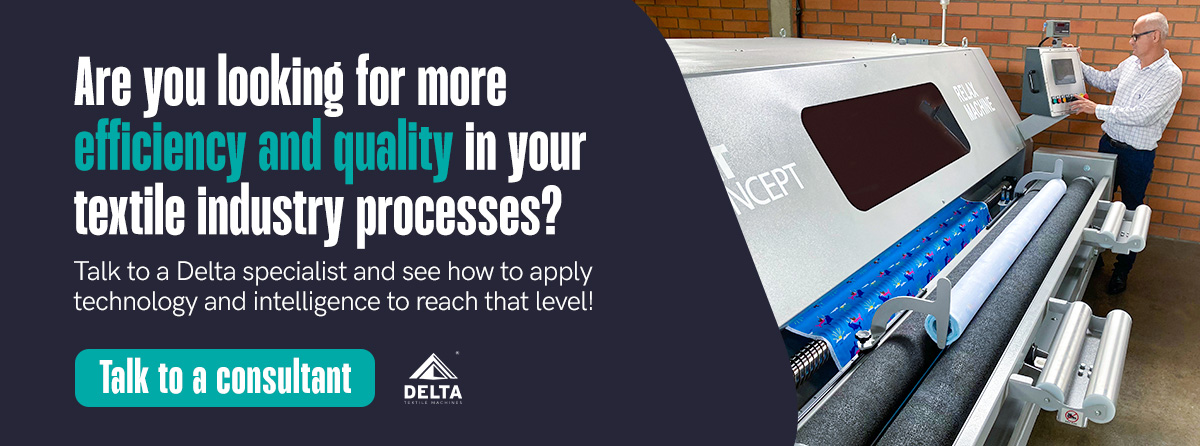
- The Relaxing Machine RLX600 eliminates the need for prolonged resting time, ensuring consistent dimensional stabilization of the fabric. This reduces the risk of variations in garments and provides greater reliability for subsequent stages.
- The Inspection Machine REV1000 generates structured data for each fabric roll. This increases process reliability, improves traceability, and enables more accurate identification of defect patterns.
- DLT Fabric View and DLT Fabric Cut enable integration between stages, allowing fabric defect information to be considered during spreading and cutting.
These Delta solutions reinforce that textile automation does not only act on isolated points, but reshapes how industrial garment manufacturing operates—making the process more integrated, predictable, and data-driven.
It is also worth noting that all these Delta solutions comply with NR12 standards, ensuring that garment automation meets mandatory safety requirements without compromising production efficiency.
The impact of Industry 4.0 on industrial garment manufacturing
Have you noticed that ensuring the evolution of industrial garment manufacturing inevitably requires adopting Industry 4.0 principles?
These principles enable the adoption of textile technology and automation, driven by data, connectivity, and operational intelligence.
It is also important to highlight the growing advancement in end-to-end data integration. This is because the information generated from fabric inspection onward forms a unified view of production.
Only in this way is it possible to:
- Identify patterns
- Correct deviations more quickly
- Continuously optimize the process
To achieve this, it is essential to rely on textile machinery that not only collects this data but also enables integration with ERP systems, allowing it to be centralized and organized.
As a result, operations gain greater transparency and alignment between departments, simplifying planning, resource management, and the monitoring of strategic indicators.
Real-time monitoring also enables bottlenecks to be anticipated and data-driven decisions to be made, raising the operational maturity level of garment manufacturing.
The predictability, efficiency, and preparedness provided by Industry 4.0 support sustainable production growth. Ultimately, the ability to integrate, analyze, and act based on data is what distinguishes reactive operations from strategically managed ones.
Also read: Clothing in Industry 4.0: what is the real productive gain?
The next step to evolving your industrial garment manufacturing
As we have seen, challenges in industrial garment manufacturing, such as waste, rework, and lack of predictability, are directly related to the absence of data and the low level of automation across production stages.
This is precisely where Delta solutions stand out. By combining high-performance machines with integrated software and NR12 certification, it is possible to transform textile production into a safer, more efficient, connected, and data-driven operation.
If your operation is looking to improve productivity, quality, and predictability, it is worth understanding in practice how these solutions can be applied to your process.
Get in touch with Delta and discover how to bring more efficiency and intelligence to your industrial garment manufacturing.